FREE LOCAL DELIVERY over $99! SHOP In-Store and Save! 408-227-7272 - DIRECTIONS


Your cart is currently empty
Product image slideshow Items
Available in store
CloseWHY GARDENERS LOVE GROW TONIC!
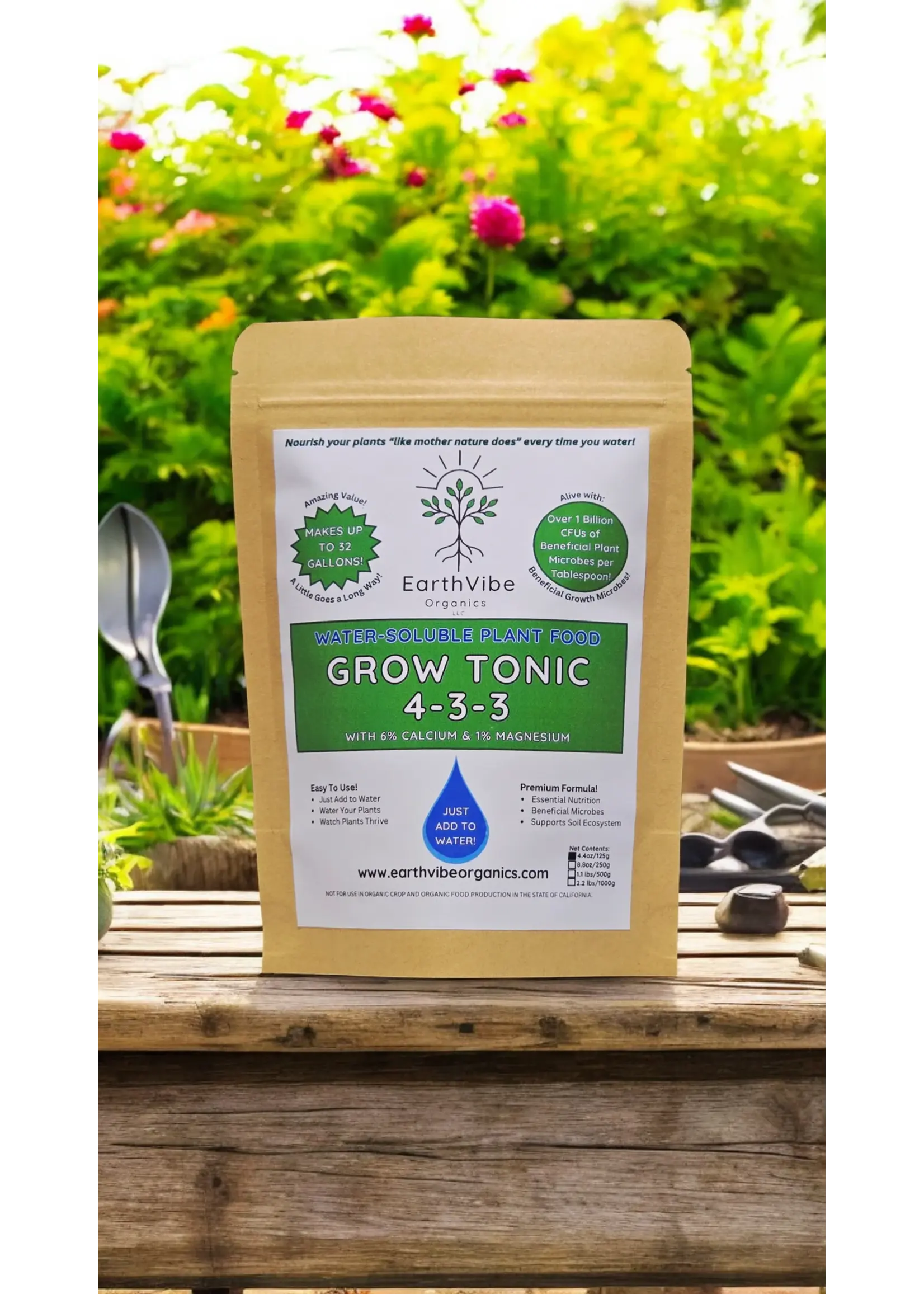
With just one tablespoon of EarthVibe Grow Tonic added to a gallon of water, our revolutionary carbon-forward, amino and humic acid-based formula provides essential NPK nutrition (4-3-3) plus essential calcium and magnesium while flooding your soil with a mega dose of over One Billion beneficial growth microbes.
Our beneficial microbial consortium includes: Endomycorrhizae Fungi (Mycos), Rhizobacteria and Trichoderma Fungi from our proprietary Bloom-specific microbe consortium (assembled by a 20yr field agronomist) that inoculate plant roots, breaking down insoluble forms of calcium, phosphorous and potassium and making them available to your plants all while supporting a healthy soil biome free from pathogens.
Our Grow Tonic formula is a truly holistic plant nutrition system that mirrors nature's own cycles, delivering exactly what your plants need at every stage of growth without synthetic chemical fertilizers that destroy your plant's delicate soil ecosystem.
Grow Tonic's essential plant nutrition and huge, diverse beneficial microbe population work together exactly as nature intended to deliver you the happiest, healthiest plants you've ever grown!
Dual-action Grow Tonic Formula Mirrors Nature's Perfect Design!
Grow Tonic's dual-action formula delivers both immediate AND long-term plant nutrition and feeds your soil with every watering. The water-soluble nutrients feed your plants instantly, giving you the fast results you demand, while the insoluble nutrients are deposited in your soil where our beneficial microbes release them as your plants' needs change throughout their lifecycle. This means your soil actually gets richer and more fertile with every application, creating a thriving underground ecosystem that supports explosive plant growth season after season!
Harness Nature's Energy And Wisdom One Tablespoon At A Time!
EarthVibe's Grow Tonic is the perfect natural growing solution! No more complex mixing ratios, no more synthetic chemicals that destroy your soil ecosystem, no more guessing what your plants need, no more watching them struggle despite your best efforts.
Grow Tonic makes all natural growing easy and gives you the confidence of knowing that with every application, you're building the foundation for the vibrant, abundant garden you've always dreamed of.
Using Earthvibe Grow Tonic Couldn't Be Easier... You Literally Can't Mess This Up!
No Unpleasant Fishy Or Manure Smelling Odors!
Unlike many organic fertilizers, EarthVibe Grow Tonic has a pleasant, malty smell that most customers actually enjoy!
Grow Tonic Is A Great Value For Your Garden!
Our smallest 1/2lb+ (8.8oz) package will make up to 64 gallons of Grow Tonic to nourish your garden organically every time you water!
See our "Bloom Elixir" listing for an all organic, all purpose bloom fertilizer with specially formulated microbe consortium to maximize blooms!
Available in multiple sizes to suit your garden needs, from sample packs to bulk quantities for serious growers.
––––––––––––––––––
GROW TONIC FAQ
––––––––––––––––––
What is a Plant Grow Tonic?
A plant grow tonic is a nutrient-rich, often organic, liquid supplement designed to support plant health, encourage strong root development, and promote consistent vegetative growth. These tonics commonly include beneficial microbes, enzymes, amino acids, vitamins such as B-1, and seaweed-derived inputs. Unlike traditional fertilizers that focus primarily on delivering macronutrients like nitrogen, phosphorus, and potassium, grow tonics function as biostimulants. They work by improving soil biology, supporting plant stress response, and helping plants access nutrients more efficiently. This role closely aligns with how EarthVibe Organics Grow Tonic is intended to be used.
Purpose:
• Support overall plant vigor
• Help plants tolerate environmental stress
• Improve nutrient uptake efficiency
Composition:
• Sea kelp or seaweed extracts
• Humic or fulvic compounds
• Beneficial microorganisms
• Fermented plant or protein inputs
• Rock Phosphate or Steamed Bone Meal
Application:
• Applied as a soil drench during watering
• Can also be used as a foliar spray to support leaf health
Benefits:
• Encourages rapid root expansion
• Supports fine root hair development
Increased Growth:
• Supports steady, healthy vegetative growth
• Helps maintain balanced foliage development
Stress Support:
• Helps plants recover from transplant shock
• Supports plants during drought, heat, or temperature swings
Usage:
• Commonly used on seedlings, cuttings, houseplants, and garden plants
• Intended to complement a base fertility program rather than replace it
How to Use/Dilution:
• Most concentrated grow tonics are diluted in water before application, such as 1 TSP to 1 TBSP per gallon of water.
Frequency:
• Often applied every 14 days or as needed during active growth periods
Why should I use a Plant Grow Tonic?
Using a plant grow tonic can support overall plant health by supplying key micronutrients, encouraging balanced growth, and helping plants better tolerate pests, disease pressure, and environmental stress. Grow tonics stimulate both root and shoot development while improving soil conditions that support nutrient availability and absorption.
Boosts Growth and Resilience:
• Helps plants manage stress from heat, cold, drought, or transplanting
• Supports plant immune response without forcing excessive growth
Enhances Nutrient Absorption:
• Improves the plant’s ability to access nutrients already present in the soil
• Helps correct minor nutrient inefficiencies
Improves Soil Health:
• Introduces or supports beneficial microbes in the root zone
• Encourages better soil structure and root interaction
Supports Yield and Quality:
• Regular use can support healthier growth cycles
• Helps maintain plant performance through the growing season
Versatile Application:
• Can be applied as a soil drench or foliar spray
• Suitable for indoor plants, gardens, and container systems
Plant grow tonics are especially useful for slow-growing, stressed, or recently transplanted plants, offering gentle nutritional support without the burn risk associated with high-salt synthetic fertilizers.
What is water-soluble plant food?
Water-soluble plant food or fertilizer refers to nutrients that dissolve completely in water. When mixed properly, they create a nutrient solution that can be easily applied during watering. This allows nutrients to be distributed evenly throughout the soil, making them readily available to plant roots and supporting healthy, consistent growth.
What is one reason not to use Miracle-Gro?
Miracle-Gro relies on synthetic chemical inputs that can negatively impact beneficial soil microbes, disrupt natural soil balance, and contribute to nutrient runoff into waterways. Over time, this approach can lead to plants becoming dependent on frequent feeding rather than developing resilient root systems and healthy soil relationships, functioning more as short-term growth stimulation than long-term plant support.
How to make water soluble plant food?
One homemade method involves placing 4 tablespoons of processed poultry manure or a blended dry organic fertilizer into a quart jar and filling it with lukewarm water. Secure the lid and shake vigorously, then allow the mixture to sit at room temperature for approximately two days. Afterward, pour off the liquid and dilute it with water to the desired strength before applying. For a more consistent and convenient option, many growers choose EarthVibe Organics Grow Tonic or Bloom Elixir. Simply add one tablespoon per gallon of water, apply during watering, and support healthy plant growth.
What are the disadvantages of water soluble fertilizers?
Risk of Over-Fertilization and Nutrient Imbalance
• Water soluble fertilizers are often highly concentrated
• Nutrients become immediately available to plants
• It is easier to apply more nutrients than needed if rates are not managed carefully
• Excess application can lead to nutrient imbalance or plant stress
Can I add water-soluble fertilizer or plant food directly in soil?
Yes, but water-soluble fertilizers are typically used at lower rates than granular or dry amendments. Many organic soil amendments are applied at rates of 2–4 tablespoons per gallon or per square foot of soil. Water-soluble formulas are more concentrated and become available to plants much faster, so it is recommended to start at lower rates such as 1 tablespoon per gallon or per square foot.
What are the Top 3 Fertilizers?
The top three fertilizer nutrients are Nitrogen (N), Phosphorus (P), and Potassium (K), commonly referred to as NPK.
• Nitrogen supports leafy, vegetative growth
• Phosphorus supports root development and flowering
• Potassium supports plant strength and overall health
The ideal balance depends on plant type, growth stage, soil conditions, and desired results, but NPK forms the foundation of most plant nutrition programs.
Is plant food better than fertilizer?
This is a common question among new gardeners. Plant food and plant fertilizer refer to the same thing. Fertilizer is the technically correct horticultural term, while plant food is more commonly used on consumer-facing products. Although plants produce their own food through photosynthesis, fertilizers provide the nutrients plants need to do so effectively.
What is NPK?
The Big Three Macronutrients (NPK)
Nitrogen (N):
• Supports green leafy growth
• Essential for chlorophyll and protein production
Forms include urea, ammonium nitrate, and anhydrous ammonia
Phosphorus (P):
• Supports root development, flowering, and fruit formation
Forms include diammonium phosphate and superphosphates
Potassium (K):
• Supports plant health, disease tolerance, and water regulation
Forms include potassium chloride and potassium sulfate
Why do plants need Calcium, Magnesium and Sulfur?
Calcium, magnesium, and sulfur are secondary macronutrients that play essential roles in plant structure, energy production, and metabolic function.
Calcium (Ca):
• Builds strong cell walls
• Supports cell division and root tip growth
• Acts as a signaling nutrient during stress
• Deficiency can result in stunted growth or blossom end rot
Magnesium (Mg):
• Central component of chlorophyll
• Required for photosynthesis
• Supports enzyme activation and sugar transport
Sulfur (S):
• Required for amino acid and protein formation
• Supports enzyme activity and chlorophyll production
• Contributes to plant defense mechanisms
Although required in smaller amounts than NPK, these nutrients are essential for healthy growth and consistent yields.
Is there a water soluble organic fertilizer?
Yes. EarthVibe Organics Grow Tonic and Bloom Elixir are examples of water soluble organic plant foods that provide readily available nutrients along with beneficial microbes, helping feed plants while supporting a healthy soil ecosystem without synthetic chemicals.
Are organic fertilizers soluble in water?
Typical organic fertilizers include animal-based inputs such as manure, slurry, guano, and processing byproducts, as well as plant-based materials like compost and biosolids. Mineral-based organic inputs such as ash or rock materials are generally not readily water soluble and must break down over time before nutrients become available.
What are the disadvantages of water soluble fertilizer?
One major concern is the potential for over-application. Because liquid fertilizers are concentrated and immediately available, applying too much can result in nutrient imbalance, root stress, or plant damage. Cost may also be a factor for some gardeners. Choosing a gentle organic option like EarthVibe Organics Grow Tonic or Bloom Elixir and following label instructions helps minimize these risks.
What is an organic fertilizer?
Organic fertilizers are derived from natural plant, animal, or mineral sources and provide essential nutrients in moderate concentrations. These can include natural materials such as manure and compost, as well as processed inputs like blood meal, humic substances, enzyme-digested proteins such as soy or fish hydrolysates, fish meal, feather meal, seaweed, rock phosphate, and bone meal.
What is the best organic fertilizer?
The best organic fertilizer depends on factors such as time, cost, application preference, and crop needs. Many traditional organic fertilizers require mixing into soil, top-dressing, or time to break down before planting. Water-soluble organic plant foods like EarthVibe Organics Grow Tonic or Bloom Elixir offer a cleaner, faster, and easier option for ongoing plant support.
Which is better, organic or chemical fertilizer?
Organic fertilizers improve soil structure, increase water retention, and support beneficial microbial activity, benefiting both plants and soil over time. Synthetic fertilizers may be easier to use and sometimes more cost-effective but can reduce soil health when relied on exclusively.
What are 5 examples of Organic Fertilizer?
Do plants prefer organic fertilizers?
Organic fertilizers offer several advantages for plant growth:
• They do not form crusts on the soil surface
• They improve water movement through soil
• They gradually build soil structure
• They support beneficial soil microbes
What are the disadvantages of organic fertilizer?
Slow Results:
• Nutrients must break down before becoming available
Inconsistent Nutrient Levels:
• Nutrient content can vary by source
Messy or Time Consuming:
• Many require top-dressing or soil mixing
• Some require time to condition soil before planting
Odor:
• Manure- or fish-based inputs may produce strong smells
Can I use too much organic fertilizer?
Yes. Although organic fertilizers come from natural sources, applying excessive amounts can still cause nutrient imbalance and potential plant stress.
What plants benefit most from organic fertilizer?
Plants with sensitive roots benefit from slow-release organic sources such as bone meal or guano. Vegetables and fruits like tomatoes, peppers, and strawberries respond well to potassium-rich organic nutrition. Fast-acting, easy-to-use options like EarthVibe Organics Grow Tonic or Bloom Elixir provide convenient support through regular watering.
How often should I fertilizer with organic fertilizer?
Always follow label instructions. Some organic fertilizers, including EarthVibe Organics water-soluble Grow Tonic and Bloom Elixir, are formulated for regular use throughout the growing season.
What is a good organic plant food?
Compost and manure are common all-purpose options. Bone meal and blood meal may be used for targeted nutrient needs. For fast-acting, easy application, many gardeners prefer EarthVibe Organics Grow Tonic or Bloom Elixir.
Is organic plant food fertilizer?
Yes. Plant food and plant fertilizer refer to the same category of products. Fertilizer is the technical term, while plant food is commonly used on consumer products.
What is an organic plant nutrient?
Organic nutrients contain carbon, the fundamental building block of life. While plants primarily absorb inorganic nutrients like water and minerals, organic nutrients play an important role through soil processes and microbial activity.
Is Miracle Gro Organic?
Miracle-Gro is not an organic fertilizer. It is produced using synthetic ingredients that rely heavily on fossil fuels and do not align with organic gardening principles.
What are the advantages of organic fertilizer?
Organic fertilizers are generally less concentrated, safer to apply, environmentally friendly, and supportive of soil ecosystems. They actively help maintain the biological balance that supports long-term plant health.
What are the advantages and disadvantages of organic fertilizer or plant food?
Organic farming offers environmental, health, and sustainability benefits but can involve more labor, time, and cost. Water-soluble organic products like EarthVibe Organics Grow Tonic and Bloom Elixir can help reduce some of these challenges.
What are 5 benefits of organic farming?
Is organic fertilizer really better?
Organically derived fertilizers often provide secondary and micronutrients that are missing from many synthetic products. While they typically have lower NPK values, they support plants and soil over a longer period.
Why does the Grow Tonic pouch say, "NOT FOR USE IN ORGANIC CROP AND ORGANIC FOOD PRODUCTION IN THE STATE OF CALIFORNIA."?
Grow Tonic is made with only CDFA Organic Input Material (OIM) approved inputs (or inputs that are candidates for OIM registration) but was initially registered as a conventional fertilizer (in California) to save on time to market and initial cost. Organic Registration is coming in 2026!
